

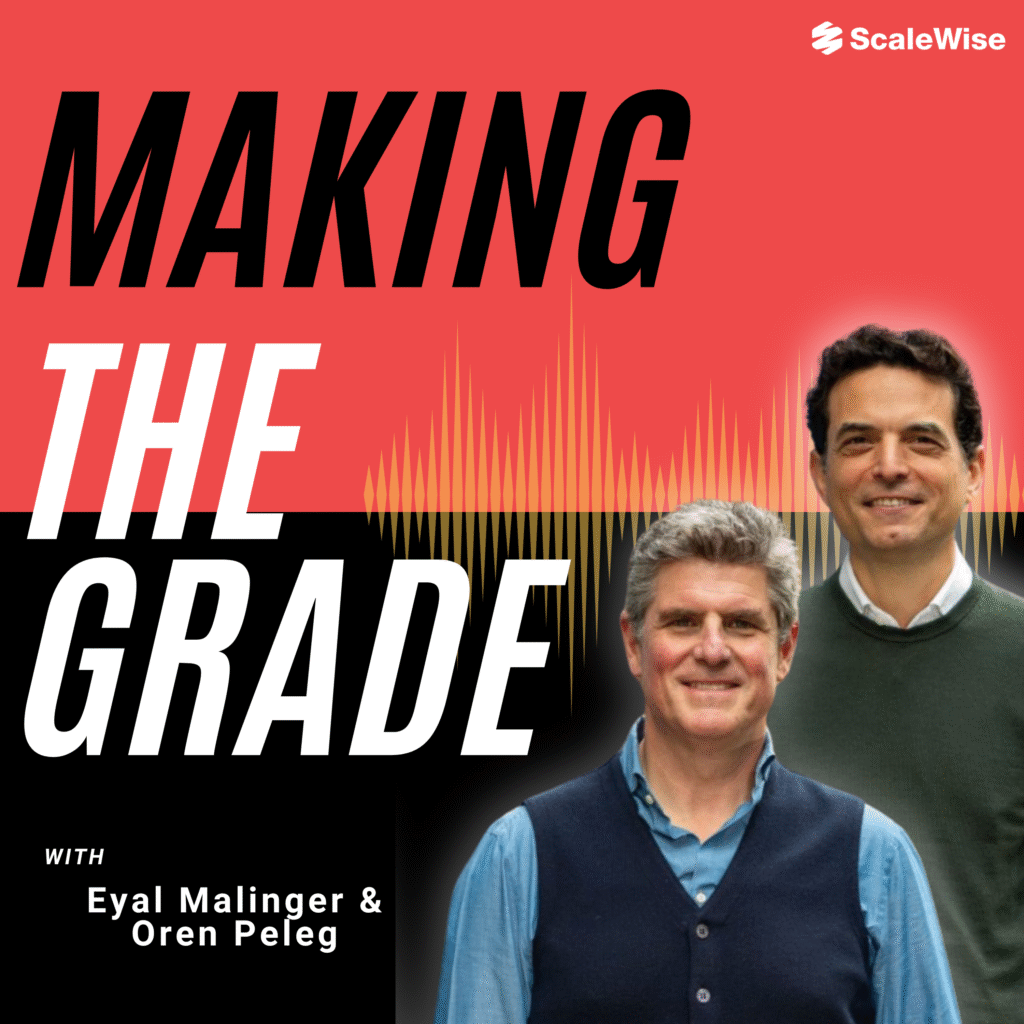
Most founders are taught there’s one playbook for scaling: raise venture, chase unicorn status, repeat. Eyal Malinger and Oren Peleg have built their careers challenging that idea.
From decades in private equity and consulting, to leadership roles in venture, to now founding Resurge Growth Partners, they’ve watched founders and investors wrestle with a simple but uncomfortable reality:
The traditional VC model only works for a tiny fraction of companies, but many “non-unicorn” businesses are still excellent, scalable and deserving of capital.
In this Q&A feature, Oren and Eyal explain why so many strong businesses fall into the gap between venture capital and private equity, how they’re disrupting the traditional VC model, the biggest mistakes they see in early scaling and what it really takes to plan for a successful exit.
These are some of the key insights from our conversation with Oren and Eyal on our Making The Grade podcast. You can listen to the full episode here.
Q: Venture Capital only works for a small minority of companies. Why is that, and what gap are you filling with Resurge Growth Partners and Venture Equity?
Eyal & Oren: “The starting point is the power-law nature of venture capital. VC funds are designed around the idea that one or two companies in the portfolio return the entire fund. Those are the ‘triple, triple, double, double, double’ outliers that can realistically get to a $1bn to $5bn+ outcome.
That creates a structural problem. There are lots of very good companies in the ecosystem, but if they “only” grow by 30% a year and don’t have Unicorn potential, they simply don’t fit what a VC fund needs to back.
While from a VC lens, that growth doesn’t move the needle enough to justify more capital, from a PE lens, 30% is a very good growth rate.
If you’re in that VC cycle, however, you can have £10-20m+ in revenue and build real products for real customers, but still struggle to raise more VC capital because you’re not seen as a fund-returner.
That’s the gap Research Growth Partners is focused on, and we’ve coined this as “venture equity” – a hybrid between venture capital and private equity. Not classic PE, because we’re backing businesses that still have a long way to go and are not “mature” buy-out candidates, but also not traditional VC, because we’re buying into companies where you can already see the traction, customers and operations processes.”
Q: For founders weighing up funding options, how should they decide whether to pursue VC or explore alternatives?
Eyal & Oren: “The first step is to really understand what it means to be venture-backed, not just the headline valuations, and to decide whether you really want to build a venture-backed business. In VC, there’s one or maybe two winners in every portfolio, and they’re the ones who will return all of the funds, and therefore these are the ones VCs really care about.
You’ll want to look at your business and ask whether what you’re building can be worth $1bn to $5bn+, because that’s the numbers VCs need to see an exit, return the fund and make money.
Alongside asking yourself these questions, it’s so important for founders to explore the world outside of venture and really look at all options before making a decision. There are lots of pools of capital out there, so you want to assess different alternatives before going all-in on the VC track.”
Q: If you’re already on the VC track but want a different outcome, how can you realistically step off it?
Eyal & Oren: “Once you’re on the classic ‘raise, burn, grow, raise again’ venture treadmill, it can feel very hard to change course. It’s almost like parallel train tracks that don’t really meet each other. You’re on the venture track, the private equity track or on the bootstrapped track.
When you’re on the venture track, you raise capital, you burn capital, you grow, and hopefully you grow enough to convince the next fund (at the next station) to give you more money.
If you want to get off that track, we’d suggest giving us a call, and we can see if we can help. But beyond that, you need to understand your strategy – where are you trying to get your company to? Maybe it’s M&A, and you want to go and find an investor who will back that strategy.
More crucially, even before you talk to anybody else, you need to understand your capital and what your current investors’ motivations are. These conversations may sometimes feel a bit uncomfortable, but they will help you understand where you are, where you want to go and what the right funding support looks like.”
Q: Changing gear a little, what are the most common mistakes you see founders make early on in the scaling journey?
Eyal & Oren: “There are a few patterns we see again and again, and many of them stem from trying to force a business into the ‘right’ narrative rather than building around what customers really want.
For example, making everything look like SaaS, even if it shouldn’t look like SaaS. Usually, this happens because SaaS gives you great payment terms to grow the business, and it gives you recurring revenue, but when you look at what the customers want, it’s a different story.
Similarly, a lot of founders start to struggle, because although they’ve seen business take off and initial growth, they suddenly tap out because they never took enough time to really understand their customers and the market they’re operating in. That early traction can often make founders and teams a bit lazy.
Marketing is a good example of that. Marketing used to be an art, and it needed to be more of a science. Now, it has become utter science, and Google and Meta have pushed marketers to become scientists. This has meant that it’s lost a bit of creativity, and we see a lot of marketing execution that is pure science and simply not enough art.”
Q: As businesses scale successfully, not every founder wants or is suited to remain CEO. What’s your advice for founders considering whether to stay at the helm or hand over the reins?
Eyal & Oren: “There’s a powerful myth in the industry – the CEO hero seed to IPO narrative. You obviously have some good examples, like Zuckerberg and others who have successfully made that journey. But they’re the exception, not the rule. We often see founding CEOs exit or move into a president or evangelist role, and there’s a non-founding CEO who comes into the seat after.
The biggest advice we can give to founding CEOs is introspection and figuring out where their energy comes from. Are you enjoying building stuff, or are you enjoying managing? Are you enjoying this scale, or are you going to enjoy it when there are 50 more people to manage? The bigger the company grows, you’ll probably build less and start managing more and more as the CEO.
If you think through these questions and discover that, actually, you really just love sales or a product. That’s great. It means you can carve out your role and bring in an MD, COO, or whatever role is most suitable.”
Q: Many founders understandably dream of an exit. What’s your biggest advice for founders looking to exit soon?
Eyal & Oren: “The biggest advice we can give is KYB – Know Your Buyer.
There’s a well-known saying: the best companies are bought, not sold. If you talk to almost any founder who has had a successful exit, you’ll find out that the company has known or worked actively as a partner with the buyer in some capacity for at least two years before the deal went through.
So, if you’re thinking about an exit, start now. Make sure you meet all the buyers and build strong relationships with them, because they are going to be the ones who are going to get you the best exit price and buyers.
It’s also worth noting that sometimes, the buyer isn’t the most obvious one. Ultimately, if you’re doing something really creative in the industry and that industry is changing, there may well be buyers that you aren’t naturally thinking about. So, you want to think broadly and have a whole range of conversations, because you never know who you might be able to convert into a buyer.”